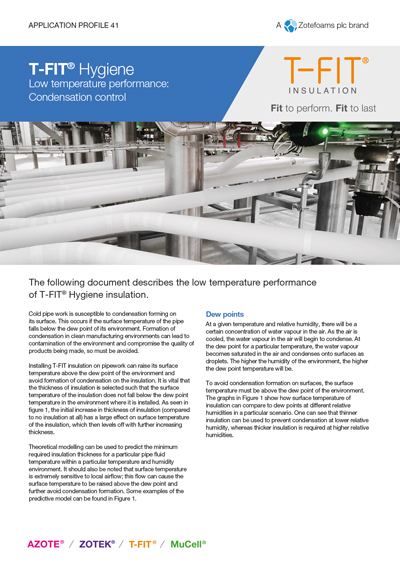
The following describes the low-temperature performance of T-FIT® Hygiene pipe insulation.
T-FIT® Hygiene is made from Zotefoams’ ZOTEK® F43HT PVDF closed cell foam, a material which has numerous benefits when it comes to cold pipe insulation, especially for frozen manufacturing.
Cold pipework is susceptible to condensation forming on its surface. This occurs if the surface temperature of the pipe falls below the dew point of its environment. Formation of condensation in clean manufacturing environments can lead to contamination of the environment and compromise the quality of products being made, so must be avoided.
Installing T-FIT cold pipe insulation on pipework can raise its surface temperature above the dew point of the environment and avoid formation of condensation on the insulation. It is vital that the thickness of pipe insulation is selected such that the surface temperature of the insulation does not fall below the dew point temperature in the environment where it is installed. As seen in figure 1, the initial increase in thickness of insulation (compared to no insulation at all) has a large effect on surface temperature of the pipe insulation, which then levels off with further increasing thickness.
Theoretical modelling can be used to predict the minimum required insulation thickness for a particular pipe fluid temperature within a particular temperature and humidity environment. It should also be noted that surface temperature is extremely sensitive to local airflow; this flow can cause the surface temperature to be raised above the dew point and further avoid condensation formation. Some examples of the predictive model can be found in Figure 1.
Dew points
At a given temperature and relative humidity, there will be a certain concentration of water vapour in the air. As the air is cooled, the water vapour in the air will begin to condense. At the dew point for a particular temperature, the water vapour becomes saturated in the air and condenses onto surfaces as droplets. The higher the humidity of the controlled manufacturing environment, the higher the dew point temperature will be.
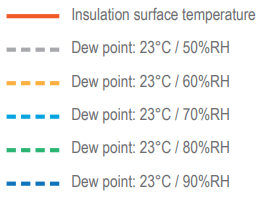
To avoid condensation formation on surfaces, the surface temperature must be above the dew point of the environment. The graphs in Figure 1 show how surface temperature of pipe insulation can compare to dew points at different relative humidities in a particular scenario. One can see that thinner insulation can be used to prevent condensation at lower relative humidity, whereas thicker insulation is required at higher relative humidities.
Figure 1: Graphs showing theoretical surface temperature of insulation against insulation thickness, compared to the dew points of different relative humidity environments. The ambient temperature chosen was 23°C and pipe size 2” NB.
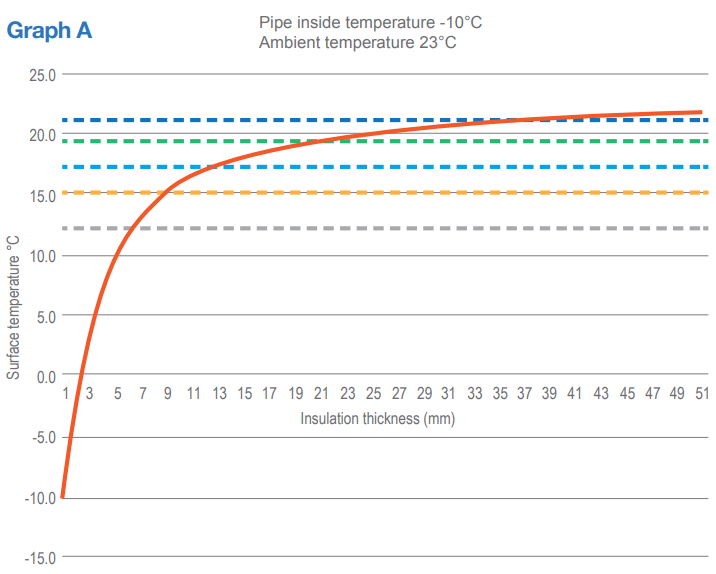
Graph A shows results for a pipe fluid temperature of -10°C.
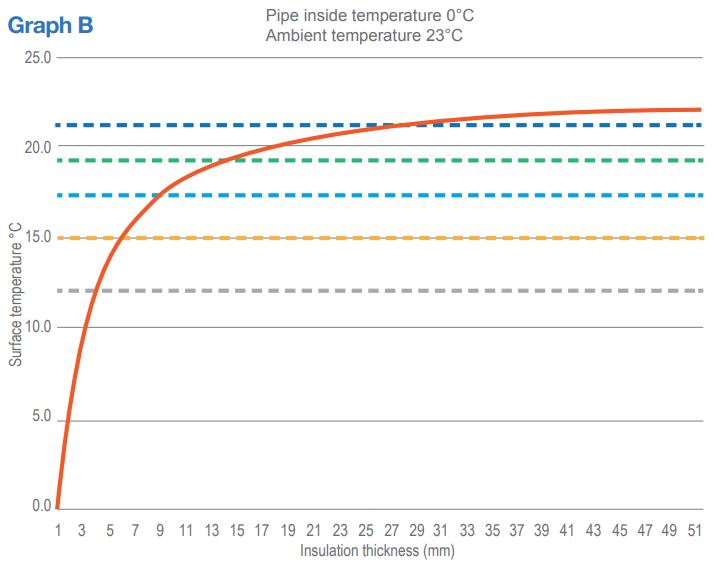
Graph B shows results for a pipe fluid temperature of 0°C.
Minimum service temperatures
Minimum service temperature does not represent any specific physical property, and thus cannot be determined by any single standardised test method. Instead, one must think of the physical properties that are important for a particular application, and whether those are adversely affected by low temperatures. Aspects to consider include induced stress from shrinkage, as well as embrittlement of material at lower temperatures combined with external forces, such as knocks and vibrations.
Dimensional changes
When insulation foams are cooled to low temperatures, they tend to shrink. The coefficient of linear thermal expansion can be used to predict dimensional changes at low temperatures. For F43HT foam below 0°C, the foam is likely to decrease in length by 1 mm per metre for every 8°C cooling. This must be considered when installing the insulation; it is advisable to install the cold pipe insulation tubes under compression. Based on the linear coefficients of thermal expansion, the graph below shows how a tube length of 950 mm installed at 25°C may change in length when a decrease in temperature occurs. Note that this relates to cooling the whole material to that temperature, whereas for tubes, only one face of the material is in contact with the cold pipe, so any dimensional changes will be less severe. Any shrinkage is also typically reversible if the material is re-heated. At extreme low temperatures, the shrinkage forces within the foam can overcome material that is constrained, and it may crack, however the temperature at which this can happen will vary depending on application.
Embrittlement
At low temperatures the stiffness of the materials changes and they can become embrittled; if machinery is subject to knocks or vibrations, then the embrittled material is prone to cracking. This can adversely affect the properties of the cold pipe insulation; if cracks form then moisture may be able to reach the pipe surface and cause corrosion. It should also be considered that low temperature cycles, leading to the repeated expansion and contraction of foam material, will put a dynamic load on the insulating tube that could lead to crack formation at low temperatures.
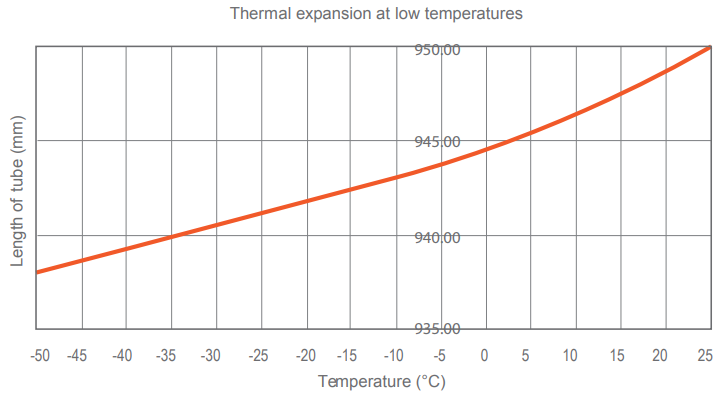
Graph showing how the length of a 950 mm long piece of ZOTEK® F43HT foam at 25°C may change when cooled to lower temperatures, predicted by the coefficients of thermal expansion of the foam.
Benefits of using PVDF for Cold Pipe Insulation
Polyvinylidene fluoride (PVDF) is a semi-crystalline thermoplastic from the family of fluoropolymers, known for their toughness and stability. It is an excellent choice for applications requiring;
- Highest purity
- Resistance to a wide range of chemicals (such as harsh cleaning agents)
- Low permeability (molecules of gas or liquid find it difficult to travel through the polymer structure)
- UV resistance
- Excellent flammability credentials
PVDF is stable over a wide range of temperatures, from negative temperatures right through to +145°C, meaning that the material can be used on cold pipelines subject to ‘Clean-In-Place’ (CIP) processes. The insulation can perform at both the chilled process temperatures and high cleaning temperatures without any loss of thermal performance over the lifetime of the product.
Exclusion of Liability
Any information contained in this document is, to the best of the knowledge and belief of Zotefoams plc and of Zotefoams Inc. (together herein referred to as ZOTEFOAMS), accurate. Any liability on the part of ZOTEFOAMS or any subsidiary or holding company of ZOTEFOAMS for any loss, damage, costs or expenses directly or indirectly arising out of the use of such information or the use, application, adaptation or processing of any goods, materials or products described herein is, save as provided in ZOTEFOAMS’ conditions of sale (“Conditions of Sale”), hereby excluded to the fullest extent permitted by law.
Where ZOTEFOAMS’ goods or materials are to be used in conjunction with other goods or materials, it is the responsibility of the user to obtain from the manufacturers or suppliers of the other goods or materials all technical data and other properties relating to those other goods or materials. Save as provided in the Conditions of Sale no liability can be accepted in respect of the use of ZOTEFOAMS’ goods or materials in conjunction with any other goods or materials.
Where ZOTEFOAMS’ goods or materials are likely to come into contact with foodstuffs or pharmaceuticals, whether directly or indirectly, or are likely to be used in the manufacture of toys, prior written confirmation of compliance with relevant legislative or regulatory standards for those applications may be requested from ZOTEFOAMS, if appropriate. Save as provided in the Conditions of Sale no liability can be accepted for any damage, loss or injury directly or indirectly arising out of any failure by the user to obtain such confirmation or to observe any recommendations given by or on behalf of ZOTEFOAMS.
ZOTEFOAMS MAKES NO WARRANTIES EXPRESS OR IMPLIED, EXCEPT TO THE EXTENT SET OUT IN THE CONDITIONS OF SALE, AND HEREBY SPECIFICALLY EXCLUDES ANY IMPLIED WARRANTY OF MERCHANTABILITY OR FITNESS FOR A PARTICULAR PURPOSE WITH RESPECT TO ANY GOODS, MATERIALS OR PRODUCTS DESCRIBED HEREIN.
T-FIT® and ZOTEK® are registered trademarks of Zotefoams plc. All rights reserved. Issue 2
Revision 6