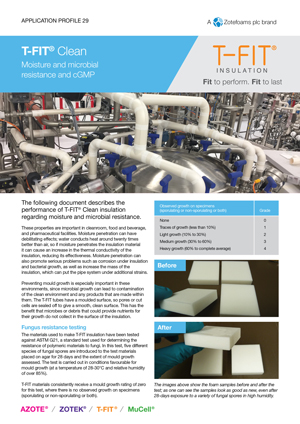
The following document describes the performance of T-FIT® Clean insulation regarding moisture and microbial resistance. It explains how the material’s closed-cell structure and moulded surface help limit moisture ingress and reduce the risk of microbial growth. The document also highlights relevant test data and discusses the suitability of T-FIT® Clean for hygienic, controlled manufacturing environments.
These properties are important in cleanroom, food and beverage, and pharmaceutical facilities. Moisture penetration can have debilitating effects; water conducts heat around twenty times better than air, so if moisture penetrates the insulation material it can cause an increase in the thermal conductivity of the insulation, reducing its effectiveness. Moisture penetration can also promote serious problems such as corrosion under insulation and bacterial growth, as well as increase the mass of the insulation, which can put the pipe system under additional strains.
Preventing mould growth is especially important in these environments, since microbial growth can lead to contamination of the clean environment and any products that are made within them. The T-FIT tubes have a moulded surface, so pores or cut cells are sealed off to give a smooth, clean surface. This has the benefit that microbes or debris that could provide nutrients for their growth do not collect in the surface of the insulation.
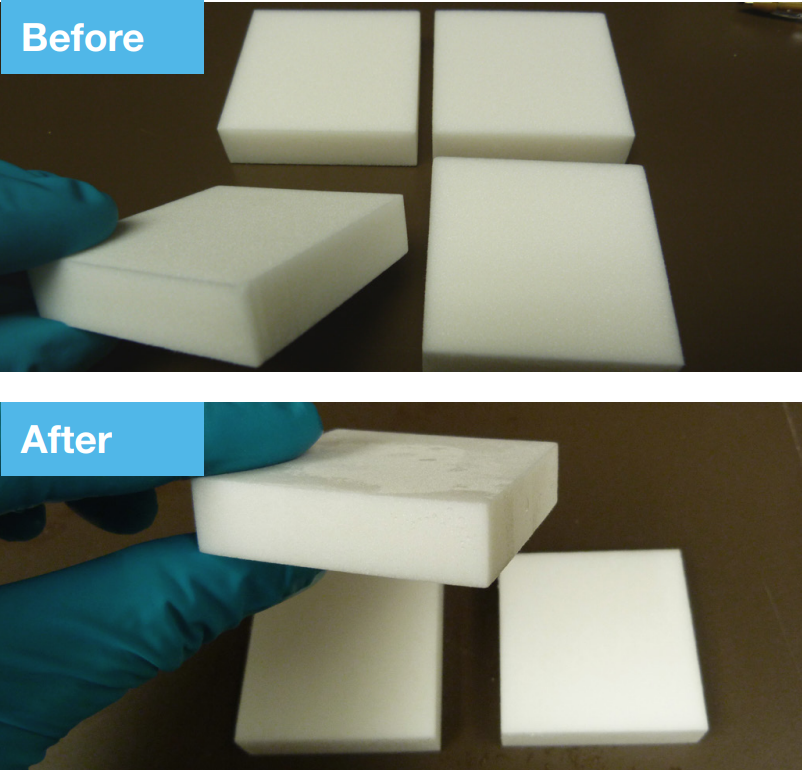
The images above show the foam samples before and after the test; as one can see the samples look as good as new, even after 28-days exposure to a variety of fungal spores in high humidity.
| Observed growth on specimens (sporulating or non-sporulating or both) | Grade |
|---|---|
| None | 0 |
| Traces of growth (less than 10%) | 1 |
| Light growth (10% to 30%) | 2 |
| Medium growth (30% to 60%) | 3 |
| Heavy growth (60% to complete average) | 4 |
Fungal resistance testing
The materials used to make T-FIT insulation have been tested against ASTM G21, a standard test used for determining the resistance of polymeric materials to fungi. In this test, five different species of fungal spores are introduced to the test materials placed on agar for 28 days and the extent of mould growth assessed. The test is carried out in conditions favourable for mould growth (at a temperature of 28-30°C and relative humidity of over 85%).
T-FIT materials consistently receive a mould growth rating of zero for this test, where there is no observed growth on specimens (sporulating or non-sporulating or both).
Moisture resistance
If moisture penetrates the insulation, then this can raise its thermal conductivity, and the insulation becomes less effective. Also, if condensation reaches the pipe surface, then this can lead to corrosion under insulation and cause severe damage. The closed cell foam material used in T-FIT Clean and T-FIT Hygiene provides a good barrier to moisture penetration; they don’t rely on cladding like most other types of insulation.
The foam materials used to make T-FIT Clean and Hygiene have high water vapour diffusion resistance indexes (µ values). These values indicate the relative reluctance of the material to allow the passage of water vapour compared to an equally thick layer of stationary air at the same temperature. A high value indicates that the insulation provides a good barrier to water vapour transmission.
For example, a 6.35 mm thick layer of T-FIT Clean insulation at 23°C has the same water vapour permeability as approximately 40 metres of air at the same temperature.
| Material | Test conditions | Indicative µ value |
|---|---|---|
| F42HTLS | Temperature: 22.0 °C Relative humidity: 49% RH Atmospheric pressure: 101 kPa | 6500 |
| F43HT | Temperature: 22.0 °C Relative humidity: 49% RH Atmospheric pressure: 101 kPa | 7500 |
Current Good Manufacturing Practices (cGMP)
Current Good Manufacturing Practices, or cGMP are the FDA’s formal regulations concerning the design, monitoring and control of manufacturing processes and facilities in the pharmaceutical industry. The FDA requires medication manufacturers to adhere to these regulations, which provide assurance that the drugs manufactured have the required strength and quality.
Manufacturers should use current technologies and systems in order to comply with the regulations. They must establish quality management systems, use highquality materials and establish standard operating procedures to guarantee good quality product. The FDA has authority to inspect manufacturing facilities to check cGMP compliance.
Facilities involving the production or distribution of medicines which use T-FIT Clean insulation have consistently passed cGMP inspections. As well as the good moisture and microbial resistance described above, T-FIT Clean insulation exhibits low outgassing and is specification tested to FM 4910. These attributes mean that T-FIT Clean is a good choice for clean manufacturing environments that need to achieve cGMP compliance.
Zotefoams’ UK manufacturing site is certified to Quality Management System – ISO 9001, in which many aspects of good manufacturing practice regulation are covered.
Exclusion of Liability
Any information contained in this document is, to the best of the knowledge and belief of Zotefoams plc and of Zotefoams Inc. (together herein referred to as ZOTEFOAMS), accurate. Any liability on the part of ZOTEFOAMS or any subsidiary or holding company of ZOTEFOAMS for any loss, damage, costs or expenses directly or indirectly arising out of the use of such information or the use, application, adaptation or processing of any goods, materials or products described herein is, save as provided in ZOTEFOAMS’ conditions of sale (“Conditions of Sale”), hereby excluded to the fullest extent permitted by law.
Where ZOTEFOAMS’ goods or materials are to be used in conjunction with other goods or materials, it is the responsibility of the user to obtain from the manufacturers or suppliers of the other goods or materials all technical data and other properties relating to those other goods or materials. Save as provided in the Conditions of Sale no liability can be accepted in respect of the use of ZOTEFOAMS’ goods or materials in conjunction with any other goods or materials.
Where ZOTEFOAMS’ goods or materials are likely to come into contact with foodstuffs or pharmaceuticals, whether directly or indirectly, or are likely to be used in the manufacture of toys, prior written confirmation of compliance with relevant legislative or regulatory standards for those applications may be requested from ZOTEFOAMS, if appropriate. Save as provided in the Conditions of Sale no liability can be accepted for any damage, loss or injury directly or indirectly arising out of any failure by the user to obtain such confirmation or to observe any recommendations given by or on behalf of ZOTEFOAMS.
ZOTEFOAMS MAKES NO WARRANTIES EXPRESS OR IMPLIED, EXCEPT TO THE EXTENT SET OUT IN THE CONDITIONS OF SALE, AND HEREBY SPECIFICALLY EXCLUDES ANY IMPLIED WARRANTY OF MERCHANTABILITY OR FITNESS FOR A PARTICULAR PURPOSE WITH RESPECT TO ANY GOODS, MATERIALS OR PRODUCTS DESCRIBED HEREIN.