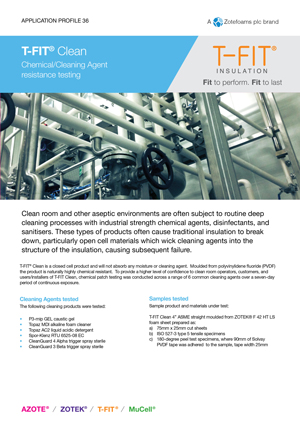
Clean room and other aseptic environments are often subject to routine deep cleaning processes with industrial strength chemical agents, disinfectants, and sanitisers. These types of products often cause traditional insulation to break down, particularly open cell materials which wick cleaning agents into the structure of the insulation, causing subsequent failure.
T-FIT® Clean is a closed cell product and will not absorb any moisture or cleaning agent. Moulded from polyvinylidene fluoride (PVDF) the product is naturally highly chemical resistant. To provide a higher level of confidence to clean room operators, customers, and users/installers of T-FIT Clean, chemical patch resistance testing was conducted across a range of 6 common cleaning agents over a seven-day period of continuous exposure.
Cleaning Agents tested
The following cleaning products were resistance tested:
- P3-mip GEL caustic gel
- Topaz MDI alkaline foam cleaner
- Topaz AC2 liquid acidic detergent
- Spor-Klenz RTU 6525-08 EC
- CleanGuard 4 Alpha trigger spray sterile
- CleanGuard 3 Beta trigger spray sterile
Samples tested
Sample product and materials under test:
T-FIT Clean 4” ASME straight moulded from ZOTEK® F 42 HT LS foam sheet prepared as:
a) 75mm x 25mm cut sheets
b) ISO 527-3 type 5 tensile specimens
c) 180-degree peel test specimens, where 90mm of Solvay PVDF tape was adhered to the sample, tape width 25mm
Chemical Resistance Testing method/process
Prior to chemical patch testing, each specimen was visually examined, followed by tensile and 180-degree peel strength testing to establish reference data. Peel strength testing was conducted at a rate of 50mm/min from which average force over a 75mm peel length was calculated.

Each specimen a), b) and c) were then covered by a cotton cloth soaked in the relevant test fluid. The cloths were re-wetted daily to ensure they did not dry out. After seven days, the cloths were removed and the specimens were examined for signs of discolouration, cracking, blistering etc, followed by tensile and peel strength testing.
Summary of Results
| Ave. Weight Change % | Tensile Strength kPa | Elongation at break % | Ave Peel Strength 75mm (N/mm) | |
|---|---|---|---|---|
| Reference | 1040 | 46.4 | 0.435 | |
| Changes in measurement following chemical patch test vs reference | ||||
| P3 gel | +1.14% | +3.8% | +15.7% | -14.5% |
| MD1 | -0.07% | -24.3% | -35.3% | -9.0% |
| AC2 | +0.04% | +4.8% | +19.8% | +0.9% |
| Spor-Klenz | -0.21% | -4.7% | +6.9% | -4.1% |
| Alpha | -0.09% | -7.0% | -8.0% | +8.3% |
| Beta | -0.10% | +8.7% | +19.2% | +3.4% |
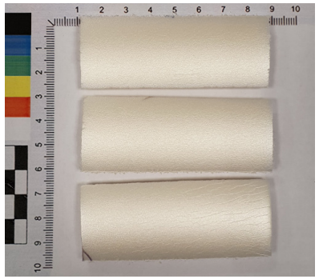
The samples showed no visible evidence of degradation such as softening, cracking, blistering or discoloration after patch testing with any of the six chemicals (Figure 2 shows an example of samples after 7-day chemical exposure).
While there is some variation in the tensile strength and elongation at break, it is considered to be typical for specimens cut from foam materials rather than due to chemical exposure.
Variation in peel strength is also considered typical of foam materials rather than due to chemical exposure. It was highlighted that none of the peel samples exhibited separation of the tape from the substrate over the duration of chemical exposure. When the peel test was conducted with these samples, it was apparent that the tape was still well adhered to the foam, with a thin layer of the foam surface remaining adhered to the adhesive tape.
Above information abbreviated from independent test documentation, full report available upon request.
Exclusion of Liability
Any information contained in this document is, to the best of the knowledge and belief of Zotefoams plc and of Zotefoams Inc. (together herein referred to as ZOTEFOAMS), accurate. Any liability on the part of ZOTEFOAMS or any subsidiary or holding company of ZOTEFOAMS for any loss, damage, costs or expenses directly or indirectly arising out of the use of such information or the use, application, adaptation or processing of any goods, materials or products described herein is, save as provided in ZOTEFOAMS’ conditions of sale (“Conditions of Sale”), hereby excluded to the fullest extent permitted by law.
Where ZOTEFOAMS’ goods or materials are to be used in conjunction with other goods or materials, it is the responsibility of the user to obtain from the manufacturers or suppliers of the other goods or materials all technical data and other properties relating to those other goods or materials. Save as provided in the Conditions of Sale no liability can be accepted in respect of the use of ZOTEFOAMS’ goods or materials in conjunction with any other goods or materials.
Where ZOTEFOAMS’ goods or materials are likely to come into contact with foodstuffs or pharmaceuticals, whether directly or indirectly, or are likely to be used in the manufacture of toys, prior written confirmation of compliance with relevant legislative or regulatory standards for those applications may be requested from ZOTEFOAMS, if appropriate. Save as provided in the Conditions of Sale no liability can be accepted for any damage, loss or injury directly or indirectly arising out of any failure by the user to obtain such confirmation or to observe any recommendations given by or on behalf of ZOTEFOAMS.
ZOTEFOAMS MAKES NO WARRANTIES EXPRESS OR IMPLIED, EXCEPT TO THE EXTENT SET OUT IN THE CONDITIONS OF SALE, AND HEREBY SPECIFICALLY EXCLUDES ANY IMPLIED WARRANTY OF MERCHANTABILITY OR FITNESS FOR A PARTICULAR PURPOSE WITH RESPECT TO ANY GOODS, MATERIALS OR PRODUCTS DESCRIBED HEREIN.