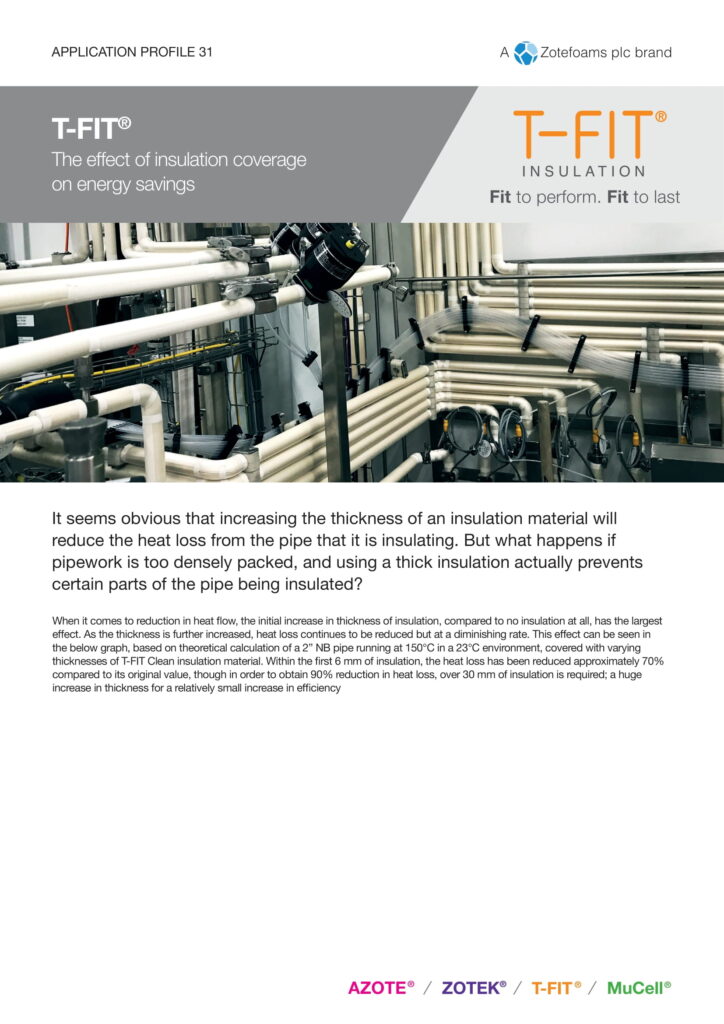
It seems obvious that increasing the thickness of an insulation material will reduce the heat loss from the pipe that it is insulating. But what happens if pipework is too densely packed, and using a thick insulation actually prevents certain parts of the pipe being insulated?
How Pipe Insulation Coverage Affects Heat Loss and Energy Efficiency
When it comes to reduction in heat flow, the initial increase in thickness of insulation, compared to no insulation at all, has the largest effect. As the thickness is further increased, heat loss from pipe insulation continues to be reduced but at a diminishing rate. This effect can be seen in the below graph, based on theoretical calculation of a 2” NB pipe running at 150°C in a 23°C environment, covered with varying thicknesses of T-FIT Clean insulation material. Within the first 6 mm of insulation, the heat loss has been reduced approximately 70% compared to its original value, though in order to obtain 90% reduction in heat loss, over 30 mm of insulation is required; a huge increase in thickness for a relatively small increase in efficiency.
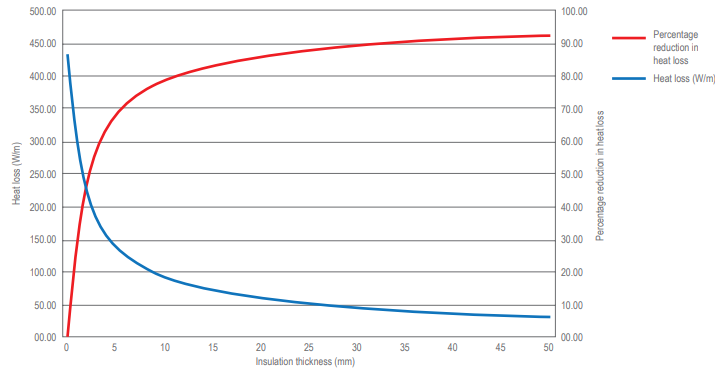
This would suggest that it is more important to ensure maximum coverage of pipework with insulation than it is to insulate easy-to-reach portions of piping with very thick insulation, leaving some pipework bare.
The following heat losses were calculated using a theoretical model for a 2” NB pipe running at 150°C in a 20°C environment. The pipe insulation heat losses in Watt/metre were then converted to total heat losses over a 100 metre install where different proportions of pipework are able to be insulated, based on the type of insulation. For the thinner T-FIT insulation 95% of the pipe work is insulated, whereas with thicker fibre-based Insulation only 75% can be insulated.
| Uninsulated pipe | T-FIT Clean | Fibre Product | |
| Insulation wall thickness (mm) | 0 | 6.35 | 25 |
| Heat loss (Watt/m) | 435 | 126 | 51 |
| Percentage reduction in heat loss for 100% insulated pipe (%) | 0 | 71 | 88 |
| Heat loss over a 100 m install (kW) [95% insulation coverage of install for T-FIT Clean / 75% coverage of install for fibre-based Insulation] | 435.0 | 141 | 147 |
| Percentage energy saving (%) | 0 | 68 | 66 |
Even though the heat loss for a segment of pipe covered with 6.35 mm T-FIT Clean is greater than that when the pipe is covered with 25 mm of fibre based Insulation, using the thinner insulation can still lead to an overall energy saving if a larger proportion of the pipework can be insulated.
It has been found in the most common type of applications for T-FIT Clean that 6.35 mm T-FIT insulation can cover 95% of process piping whereas traditional, thicker insulation materials are only able to cover 75%. It can be seen in the table above that in this 95 vs. 75% situation, 6.35 mm T-FIT Clean can actually provide similar or greater heat loss reduction, energy, and cost savings overall compared to 25 mm of other insulation materials.
Exclusion of Liability
Any information contained in this document is, to the best of the knowledge and belief of Zotefoams plc and of Zotefoams Inc. (together herein referred to as ZOTEFOAMS), accurate. Any liabilityon the part of ZOTEFOAMS or any subsidiary or holding company of ZOTEFOAMS for any loss, damage, costs or expenses directly or indirectly arising out of the use of such information or the use, application, adaptation or processing of any goods, materials or products described herein is, save as provided in ZOTEFOAMS’ conditions of sale (“Conditions of Sale”), hereby excluded to the fullest extent permitted by law.
Where ZOTEFOAMS’ goods or materials are to be used in conjunction with other goods or materials, it is the responsibility of the user to obtain from the manufacturers or suppliers of the other goods or materials all technical data and other properties relating to those other goods or materials. Save as provided in the Conditions of Sale no liability can be accepted in respect of the use of ZOTEFOAMS’ goods or materials in conjunction with any other goods or materials.
Where ZOTEFOAMS’ goods or materials are likely to come into contact with foodstuffs or pharmaceuticals, whether directly or indirectly, or are likely to be used in the manufacture of toys, prior written confirmation of compliance with relevant legislative or regulatory standards for those applications may be requested from ZOTEFOAMS, if appropriate. Save as provided in the Conditions
of Sale no liability can be accepted for any damage, loss or injury directly or indirectly arising out of any failure by the user to obtain such confirmation or to observe any recommendations given by or on behalf of ZOTEFOAMS.
ZOTEFOAMS MAKES NO WARRANTIES EXPRESS OR IMPLIED, EXCEPT TO THE EXTENT SET OUT IN THE CONDITIONS OF SALE, AND HEREBY SPECIFICALLY EXCLUDES ANY IMPLIED WARRANTY OF MERCHANTABILITY OR FITNESS FOR A PARTICULAR PURPOSE WITH RESPECT TO ANY GOODS, MATERIALS OR PRODUCTS DESCRIBED HEREIN.
T-FIT® and ZOTEK® are registered trademarks of Zotefoams plc. Kynar® is a registered trademark of Arkema Inc. All rights reserved Issue 2 Revision 2 January 2021